SECOND CALL FOR PAPERS

Dear Colleagues,

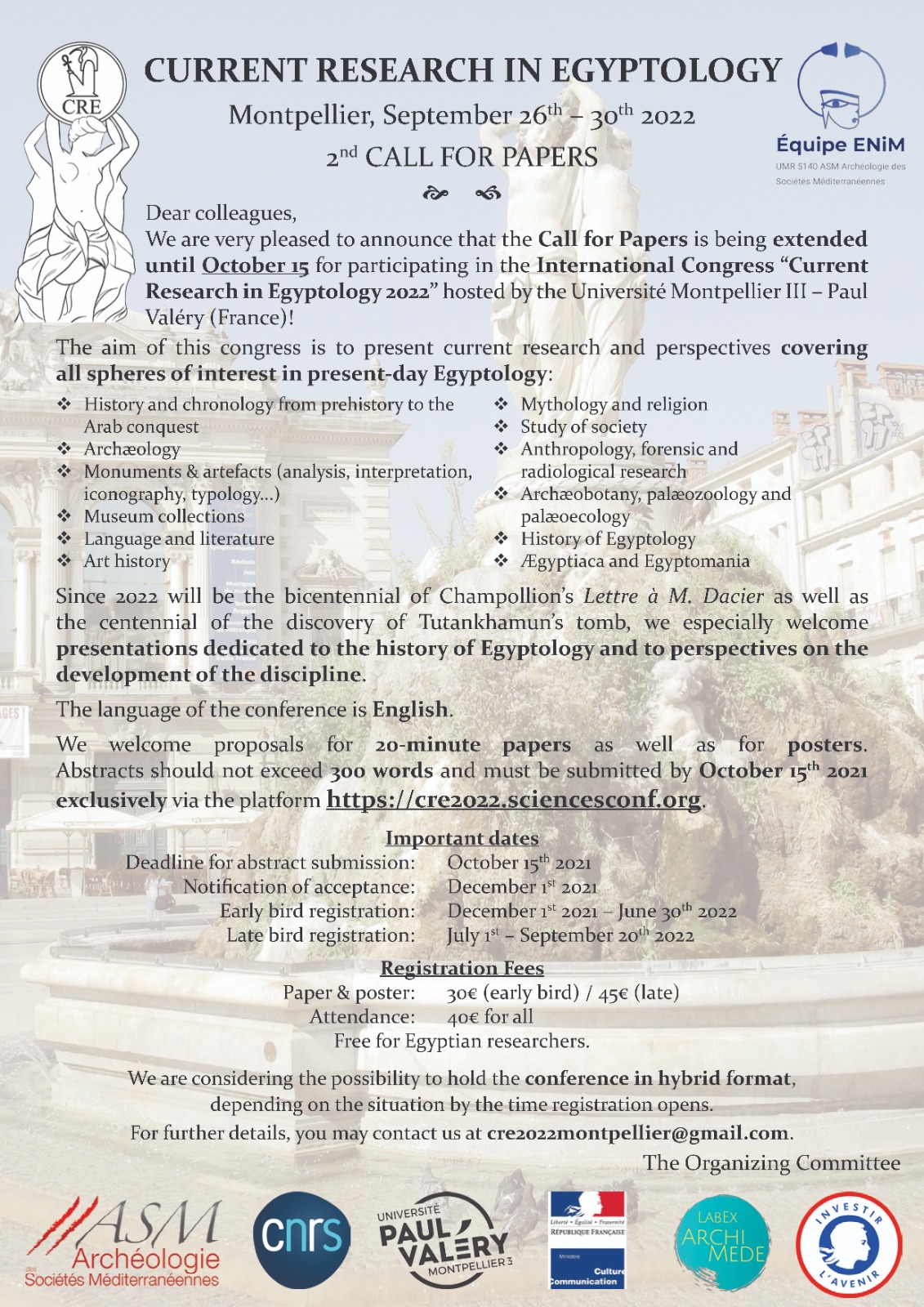
We are very pleased to inform you that the Call for Papers is being extended until October 15 for participating in the International Congress “Current Research  in Egyptology 2022” hosted by the Université Montpellier III- Paul Valéry (France)!
img-20211001-wa0005-1

CRE 2020 REVIEWING PROCEDURE

All abstracts and the papers for the CRE conference proceeding volume will be peer reviewed by three external reviewers before selection.

Abstracts

Abstracts for the conference will be assessed by the Organising Committee in accordance with the following guidelines:

  1. All abstracts will be reviewed ‘blind’ (i.e., no names, institutional affiliation, email or identifying markers attached to abstracts). The list of all submissions will be given to the reviewers with only their title, abstract and a number used to identify that submission.
  2. The main reviewing criteria include: a) Quality of overall abstract, content, and aim, b) Interdisciplinary methodology and cross-cultural approaches used, c) The ability of topic to garner overall interest (new research and on-going new research).
  3. Each of the reviewers will be asked to mark each abstract as ‘Yes,’ ‘No’, or ‘Maybe.’ Each answer is given a numerical value: Yes (1), No (0), Maybe (0.5). All votes will then be summed and will be given a Total Review Score (hereafter, TRS).

Papers

It is the responsibility of the Organising Committee to edit and publish the CRE proceedings in accordance with the Author Guidelines and the following guidelines:

  1. All submissions will be peer-reviewed ‘blind’ (i.e., no names, institutional affiliation, email or identifying markers attached to abstracts). The submissions will be given to the reviewers with only their title, text of the work and illustrations, and a number used to identify that submission.
  2. The review grading criteria should include: a) Quality of overall paper, concerning aims, methodology, content, argumentation, b) Originality of research topic, c) Quality of academic written English. Is is advisable that the final paper will be reviewed by a native speaker before submission.
  3. Each submission will be peer-reviewed by at least one, but preferably two academic reviewers. Each of the reviewers will mark papers with a numerical value from 1 (Rejected) to 4 (Accepted, with minor revisions). All votes will then be summed and will give a TRS.
  4. All submissions will receive written feedback, with comment on how the paper meets (or does not meet) the above criteria; however, the TRS will not be provided.

CRE 2020 REVIEWING PROCEDURE

All abstracts and the papers for the CRE conference proceeding volume will be peer reviewed by three external reviewers before selection.

Abstracts

Abstracts for the conference will be assessed by the Organising Committee in accordance with the following guidelines:

  1. All abstracts will be reviewed ‘blind’ (i.e., no names, institutional affiliation, email or identifying markers attached to abstracts). The list of all submissions will be given to the reviewers with only their title, abstract and a number used to identify that submission.
  2. The main reviewing criteria include: a) Quality of overall abstract, content, and aim, b) Interdisciplinary methodology and cross-cultural approaches used, c) The ability of topic to garner overall interest (new research and on-going new research).
  3. Each of the reviewers will be asked to mark each abstract as ‘Yes,’ ‘No’, or ‘Maybe.’ Each answer is given a numerical value: Yes (1), No (0), Maybe (0.5). All votes will then be summed and will be given a Total Review Score (hereafter, TRS).

Papers

It is the responsibility of the Organising Committee to edit and publish the CRE proceedings in accordance with the Author Guidelines and the following guidelines:

  1. All submissions will be peer-reviewed ‘blind’ (i.e., no names, institutional affiliation, email or identifying markers attached to abstracts). The submissions will be given to the reviewers with only their title, text of the work and illustrations, and a number used to identify that submission.
  2. The review grading criteria should include: a) Quality of overall paper, concerning aims, methodology, content, argumentation, b) Originality of research topic, c) Quality of academic written English. Is is advisable that the final paper will be reviewed by a native speaker before submission.
  3. Each submission will be peer-reviewed by at least one, but preferably two academic reviewers. Each of the reviewers will mark papers with a numerical value from 1 (Rejected) to 4 (Accepted, with minor revisions). All votes will then be summed and will give a TRS.
  4. All submissions will receive written feedback, with comment on how the paper meets (or does not meet) the above criteria; however, the TRS will not be provided.

Jaroslav Černý Library

Jaroslav Černý Library


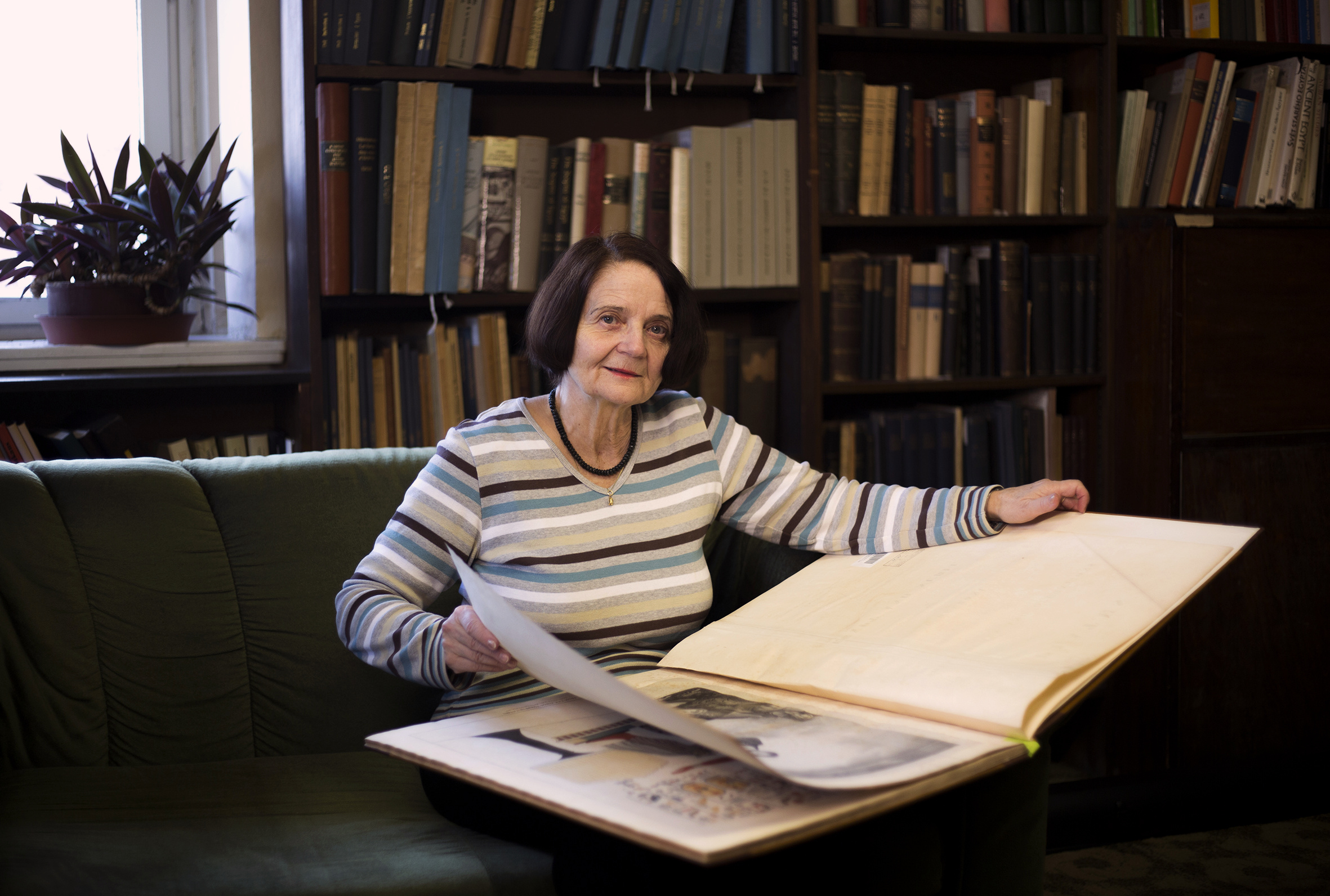
The Jaroslav Černý Library is the library of the Czech Institute of Egyptology, founded in the year 1925. Its foundation and long-term development in terms of the Egyptological Seminar of the Faculty of Arts, Charles University, was above all the work of František Lexa. The books were at that time acquired from various sources, and it is possible that Lexa himself acquired some of the older prints for the library at that time.

The library was significantly enlarged by the transfer of the private Egyptological library of Jaroslav Černý after his death in the year 1971. The library’s collections were thus enriched by numerous important and at that time already unavailable publications. Černý had been building his library systematically over many years, and thanks to his wide contacts with the Egyptological circles, he acquired in exchange for his own publications or quid pro quo a number of valuable titles as well as a wide range of offprints. In the course of the following years, the library was enriched by books from the estates of other individuals connected with Czech Egyptology, for example from the library of Ludmila Matiegková, Lexa’s pupil.

Exchange – for the publications of the institute – remained important also in the subsequent two decades. The rising volume of the Institute’s own production as well as the increased funding in the last 15 years opened up new possibilities and the library has been growing by 300 to 350 volumes a year. Besides purchase, a number of titles are still acquired by exchange and gifts.

img_5070_male-rozl

The library not only collects the newest Egyptological publications and keeps up with the highest specialist standards, but it also houses rare prints, old traveloques, period guides and picture books. The Jaroslav Černý Library takes care about these often artistically very valuable publications, restores them, and is currently restoring selected volumes in cooperation with the National Library of the Czech Republic.

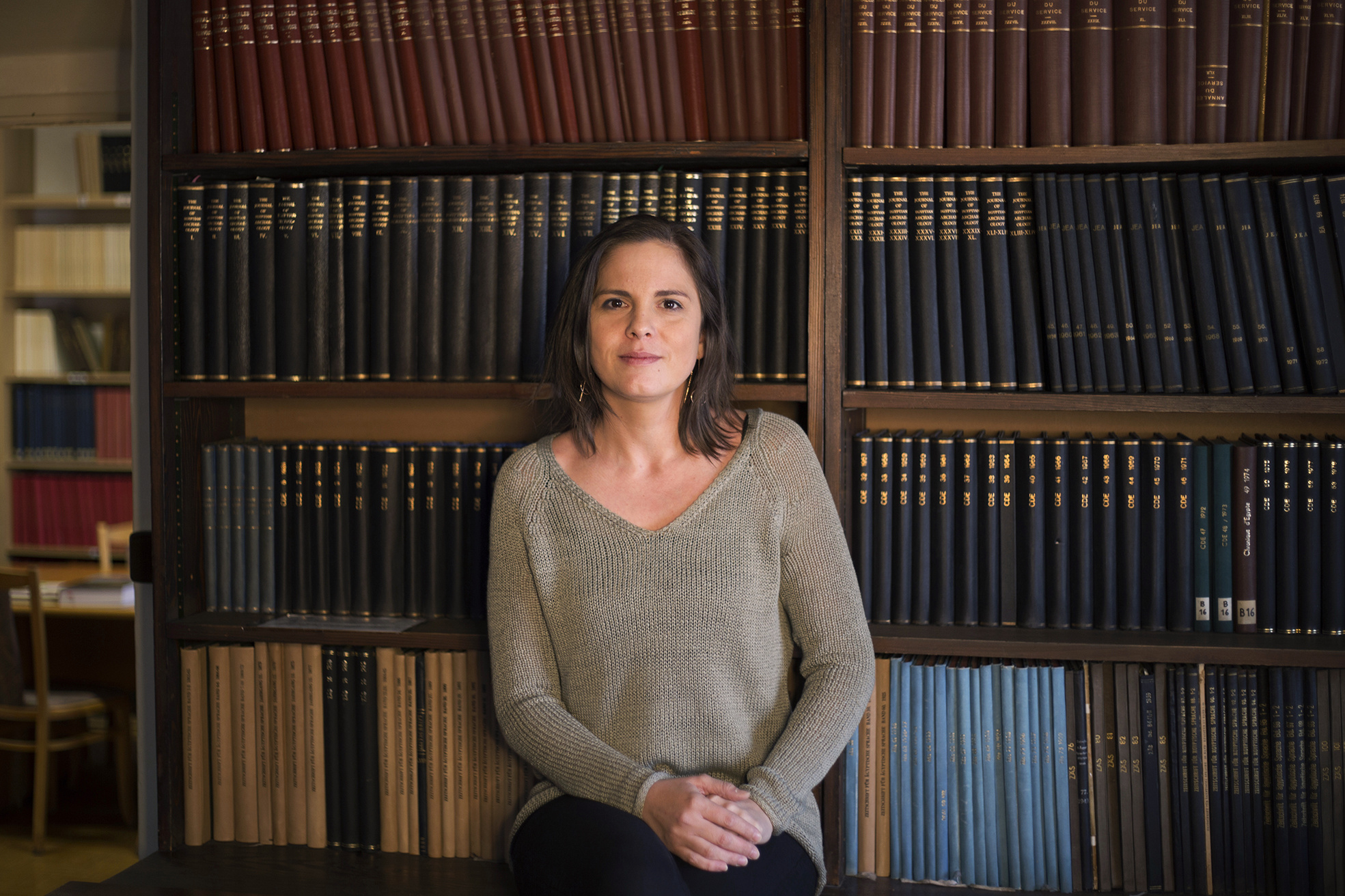
The library’s collections currently contain over 900 monographs, over 5000 offprints and about 2500 volumes of periodicals. The library offers direct exchange of Egyptological monographs published by the Charles University with various libraries, institutions and private individuals (currently we have about 170 contacts). In terms of its scope, the library represents one of the most extensive Egyptological libraries in Europe and the only one of its kind in the Czech Republic.

img_5027_ivana_male-rozl

Egyptology in Prague

EGYPTOLOGY IN PRAGUE


In the Czech Republic, Egyptology can be found at two departments: the Czech Institute of Egyptology, Faculty of Arts, Charles University cegu.ff.cuni.cz and the Náprstek Museum of Asian, African and American Cultures, National Museum in Prague http://www.nm.cz/?xSET=lang&xLANG=2.


The work of the Czech Institute of Egyptology is mainly devoted to archaeological excavations at Abusir in Egypt and to the schooling of future generations of researchers.

abusir_map

History

Egyptology in the Czech countries has a fairly long history (for the 50th anniversary of the Czech Institute of Egyptology, see https://www.youtube.com/watch?v=9-Plj-bTMXI).

The discipline already featured earlier at the German University in Prague in 1882 (for the history of German Egyptology in Prague, see http://ceguold.ff.cuni.cz/pdf/Egyptologie%20na%20UK.pdf).

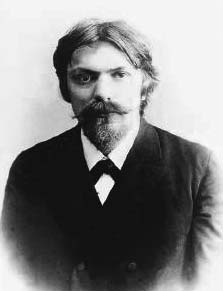
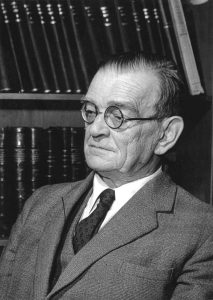
František Lexa, the author of a study on ancient Egyptian religion and of a grammar of demotic, is the founder of Czech(oslovak) Egyptology. Thanks to him, a Seminar of Egyptology was established at the Faculty of Arts of the Charles University in 1925. He became Professor for Egyptology at the Charles University two years later.

lexa

Furthermore, among his students featured Jaroslav Černý, one of the most important Egyptologist of the last century and professor of Egyptology in London and Oxford, UK.

cerny

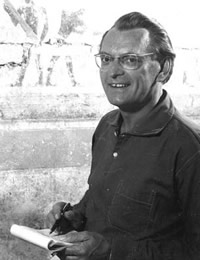
The establishment of the Czech (former Czechoslovak) Institute of Egyptology at the Charles University in Prague and Cairo in 1958 was closely connected to the UNESCO salvage campaign in Nubia throughout the 1960’s. The institute was directed by another student of Lexa, Zbyněk Žába, at this time (see also https://www.youtube.com/watch?v=0D8acbzjXx4). After the Nubian campaign, the Institute focused its interest to Abusir.

zaba

Abusir

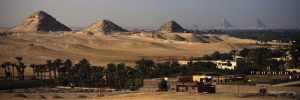
The Abusir necropolis consists of three main sectors:

  1. Royal Cemetery at Abusir, with royal pyramids from the Fifth Dynasty and a necropolis of members of the royal family (for the latest excavations, see, for instance, AC 31: http://cegu.ff.cuni.cz/en/2015/01/06/the-expedition-of-czech-institute-of-egyptology-has-discovered-tomb-of-an-unknown-ancient-egyptian-queen/).

abusir_1

  1. Abusir West, with the Saitic-Persian shaft tombs of high dignitaries and army commanders like Udjahorresnet, Iufaa (https://www.youtube.com/watch?v=7eGDdJH0D4M), Menekhibnekau (http://cegu.ff.cuni.cz/en/2007/11/22/the-shaft-tomb-of-menekhibnekau/) and Padihor.

abusir_2

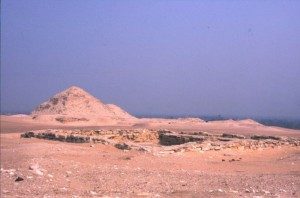
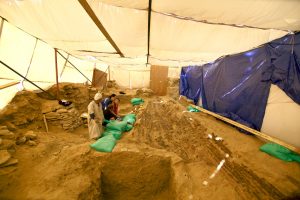
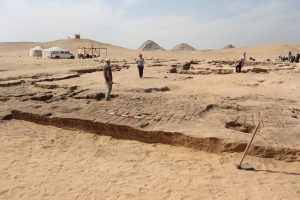
  1. Abusir South, an Old Kingdom necropolis of dignitaries with a large number of important discoveries, for instance a Third Dynasty boat http://cegu.ff.cuni.cz/en/2016/02/01/a-unique-boat-from-the-pyramid-age-discovered-at-abusir-by-the-expedition-of-the-czech-institute-of-egyptology/, the tomb complex of Princess Sheretnebty AS 68, http://cegu.ff.cuni.cz/en/2012/11/06/ground-breaking-discoveries-in-abusir-south/. Moreover, a Ramesside temple was excavated as well http://cegu.ff.cuni.cz/en/2017/10/15/a-new-temple-of-ramesse-ii-discovered-in-abusir/.

abusir_3a

22467732_12155483685_171016-082830_kro.jpg

Except for Abusir, the Institute also conducts excavations in the Western Desert and in Sudan.

Western Desert

El-Hayez

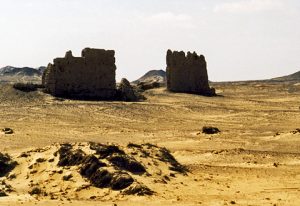
The works are devoted to the hitherto only little explored area of the El Hayez oasis, located about 50 km to the south of Bahriya. This includes a settlement from the time of the pyramid builders as well as a large Christian settlement at the site of Bir Shawish.

hayez

Sudan

Jebel Sabaloka

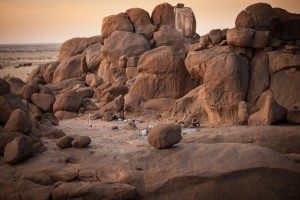
Since 2009, at Jebel Sabaloka in the Sixth Nile cataract region, settlements from the Mesolithic (Ninth–Sixth Millennia BC) and the Neolithic (Fifth–Fourth Millennia BC) are being investigated.

sabaloka

Usli

The site of Usli is located on the left bank of the Nile, about 40 km southwest of the Fourth Cataract. The archaeological excavation of the Czech expedition uncovered remnants of a significantly damaged stone temple from the Napatan Period (ca. 900–300 BC). There are some indications that the origin of the building may date back to the time of the Egyptian viceroyalty (ca. 1550–1069 BC).

usli

Conferences

The institute hosts on a regular basis renowned international congresses, such as Abusir and Saqqara and The Crossroads, and issues the proceedings of these and numerous other congresses.

http://cegu.ff.cuni.cz/en/research/conferences-since-2013/ and http://cegu.ff.cuni.cz/en/research/conferences-2005-2011/.


Publications

To present the results of our research to the wider scientific and well as general public, the Czech Institute of Egyptology publishes a wide variety of studies covering numerous aspects of ancient Egypt and Nubia (e.g. archaeology, history, religion, language, iconography, medicine, etc.; see http://cegu.ff.cuni.cz/en/research/publications/). The most important results of the institute’s archaeological research in Egypt is covered in the Abusir-series. The institute also issues the proceedings of the numerous congresses it hosts as well as collected studies and books in both English, German and Czech. Besides scholarly volumes, a number of our publications aims to introduce ancient Egypt to the public, including the translation of selected works in Arabic (see http://cegu.ff.cuni.cz/en/research/electronic-publications/publication-programme-of-czech-institute-of-egyptology-in-arabic/). Up-to-date information on the research in Egypt, Sudan as well as in Prague can be found in the biannual Czech–English magazine Prague Egyptological Studies (PES), published since 2002. (https://pes.ff.cuni.cz/en/). The English issue is dedicated to Third Millennium BC Egypt and Sudan. A selection of older publications is available in pdf format (E-publications; see http://cegu.ff.cuni.cz/en/research/electronic-publications/).